Posts

Showing posts with the label Children

Beginning Crochet With Children

Image
The very first step in leaning how to crochet is to make a chain of stitches. Although crochet seems easy once learnt, it is surprising how difficult the physical action of making the very first stitches can be having never done it before. So, to practice chain stitch and do more and more chain stitch until it comes naturally, is a good thing that children can do to help themselves to progress further. Children and beginners will find it difficult to follow a pattern or even do a row of single crochet without the ability to hold the yarn at the right tension for it to slide easily through the stitches. The action of the wrist of the hand that holds the hook when making stitches is also something to be acquired. Chain and more chain is the way to go! Here is how to do a slip knot and chain stitch But what can you do with all the lengths of chain once they have been made? Well, simply making them might be enough to satisfy some children. Others might want to see a purpose, not just...
Embroidery Stitches for Children

Image
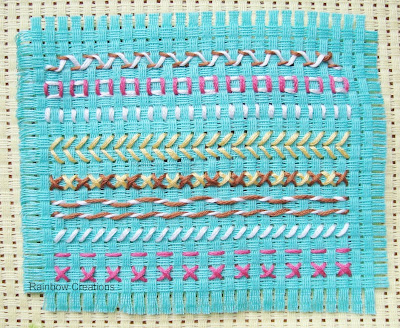
Some simple embroidery stitches that children can learn to do themselves, many of which are variations of one type of simple stitch. Embroidery Stitches for Children The stitches here are purely based on a running stitch (up one hole, down the next)  or a cross stitch (up one then diagonally down one). Depending on the direction, or the angle of the needle, variations can be sewn. Teaching children to thread a needle if your child is right handed, (reverse for left handed), bring one end of the thread round until it meets the other thread, forming a loop and hold in your left hand. Hold tightly between your thumb and finger, insert the  needle into the little loop, eye first, and pull tightly away from the thread to make the loop firmer. Push the end of the loop through the eye of the needle. Threading the needle To begin sewing , turn to the back of the fabric and thread the needle though the raised weave of the canvas for 2 or 3 stitches. Push the needle throug...

Learning To Sew Using Binca

Image
No matter the age, binca is an excellent fabric for children to learn to sew with. Because it is an open weave fabric, the holes are already in place to push the needle though, up and down, making the use of it an easy sewing activity for children. Binca is suitable for a large needle to pass through, which is why children's plastic sewing needles , chunky or slim, are the perfect choice for young children to sew on binca with. Older children can use a metal sewing needle with a large eye for easy threading. Large plastic needles are ideal for young children to use as they are safe and the holes in binca are large enough for the needle to pass though. Chunky needles are great for little fingers to grip, whereas slimmer ones are more suitable for those with a little more dexterity, wishing to create a specific stitch or design on the fabric. We think that wool , yarn or embroidery thread   make ideal threads for children to use with binca. A finer thread would not be seen t...

Favorite Christmas Craft Supplies for Children

Image
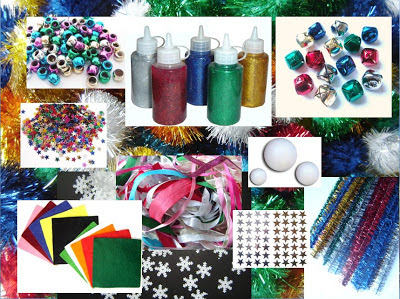
Favourite Children's Craft Supplies for Christmas Activities Tinsel Pom Poms  Metallic Pipe Cleaners  Metallic Pony Beads Snowflake Sequins Felt Ribbons Glitter glue Glitter Stars Polystyrene Balls Star Stickers Children can make so many decorations, cards, simple gifts from these few items.  For our full range - Children's Christmas Craft Supplies For ideas using these materials and more, we have a Pinterest board with all kinds of festive creations Children's Christmas Craft Ideas

Are You Creative?

Image
For children to be given the chance to be creative they need space, opportunity, encouragement and assistance. Some adults might shy away from offering this to the children in their care as they feel that they are not creative themselves.  As Henri Matisse said Creativity Takes Courage Rather than fear creativity, see it as a challenge -  a challenge which will benefit both adult and child. If you are feeling I've never been good at making things I wouldn't know where to start I have no imagination I am useless with my hands.......  Some points to think about You can learn together - good for emotional bonding It doesn't have to 'look 'right - there is no right and wrong Experiment - different materials, different approaches, even different moods It is just for fun - no pressure Things you could do to inspire and build your confidence in your own creativity Examine art and design in the small world that you live - look in your home, in catalo...

Printmaking for Children - Introducing the Brayer

Image
Simple printmaking can be done at a very young age. Children can print with any objects that has a shape and a relatively flat surface. Potato printing is a traditional method of printing for young children, where by a shape is cut into the surface of half a potato. Other vegetables can be use for their difference in shape. Painting on half of a sheet of paper and then folding the paper over is another method of printing by mirroring the applied paint on the opposite side of the paper. Finger paintings also can be printed - a pool of paint on a slippery surface, such as a tray, can be swirled around and drawn in with the fingers then printed by placing paper over the top and rubbing firmly.   Household objects can be printed with or any thing which had an interesting texture, such as cotton reels, potato mashers, toy cards, cups etc.   Printing with sponge shapes Printing sponges Foam dabbers Foam dabbers make wonderful prints which can be join...

Making a Children's Craft Box

Image
The best type of box to hold children's craft supplies is a container that is inexpensive. The reason is, that as you collect craft materials for your child to use, you will find that the need for a bigger box comes quite quickly. A large shoe box with a lid, covered with either wrapping paper or plain paper, such as brown paper or coloured paper, is a good size box to start off with. Your child could decorate or personalise their box, once covered.  As you progress to a larger box, you could add handles, to carry with, made from thick cord - the type found on gift bags is suitable. Contents When filling a craft box for children, the best thing is to offer a range of craft supplies which can be used in different ways. What to put in a children's craft box Basic equipment you will need Paper scissors, glue spreaders and glue Materials to work with The following craft supplies will provide your child with materials to work with. T...